No ab exercise burns belly fat on its own. Crunches, planks and leg raises strengthen the muscles underneath, but the fat on top shrinks only when your overall body fat goes down.
That doesn’t make core work pointless. A strong midsection helps you brace, lift, carry and twist with control, and it’s part of the strength training adults are advised to do every week.
This guide covers what the spot-reduction research shows, six core exercises with form cues, a 10-minute routine you can do at home, and the habits that actually reduce belly fat.
Can ab exercises burn belly fat?
The belief that training a muscle burns the fat sitting on top of it is called spot reduction. The studies below tested it directly, and none found that it worked.
A 12-week trial in 40 women with overweight or obesity reached the same conclusion. Both groups followed a diet, and one also did abdominal resistance exercises. Both groups lost weight and belly fat, measured by ultrasound, but the extra ab training made no significant difference.
Fat loss can even show up somewhere other than the muscle you train. In a small 2013 study, 11 young adults worked only one leg on a leg press, with very high reps, three times a week for 12 weeks. They lost fat overall, but the drop came mainly from the arms and trunk, not from the trained leg.
Ab exercises also burn relatively few calories. The 2024 Adult Compendium of Physical Activities lists light calisthenics such as curl-ups, crunches and planks at 2.8 METs, compared with 4.8 METs for brisk walking. For a 154-lb (70-kg) adult, that’s roughly 100 calories in 30 minutes of ab work versus about 170 for a brisk walk.
What core training does do
The 2011 trial also shows what ab training is good for. After six weeks, the exercise group averaged 47 curl-ups on the final test, compared with 32 in the group that didn’t train.
The CDC lists the abdomen among the major muscle groups adults should work at least 2 days a week, along with the legs, hips, back, chest, shoulders and arms. Core exercises are one piece of that, not a replacement for full-body strength work.
In everyday terms, your trunk links your upper and lower body. Training it helps you hold your spine steady when you carry groceries, pick up a child or lift weights.
Six core exercises with form cues
These six cover the main jobs your core does: resisting arching, resisting sideways bending, resisting rotation and curling the trunk. All of them work at home on a mat, and one uses a resistance band.
Dead bug
Lie on your back with your arms pointing at the ceiling and your hips and knees bent to 90 degrees. Slowly lower one arm and the opposite leg toward the floor, return, then switch sides.
- Cue: Keep your lower back gently pressed toward the floor the whole time.
- Easier: Move only your legs, tapping one heel to the floor with the knee bent.
Curl-up
Lie on your back with one knee bent and the other leg straight, hands under the small of your back. Lift your head and shoulders just off the floor, hold for a slow breath or two, then lower.
- Cue: Think “lift the chest,” not “pull the head.” Keep your neck long and your chin slightly tucked.
- Avoid: Yanking your head forward or curling all the way up.
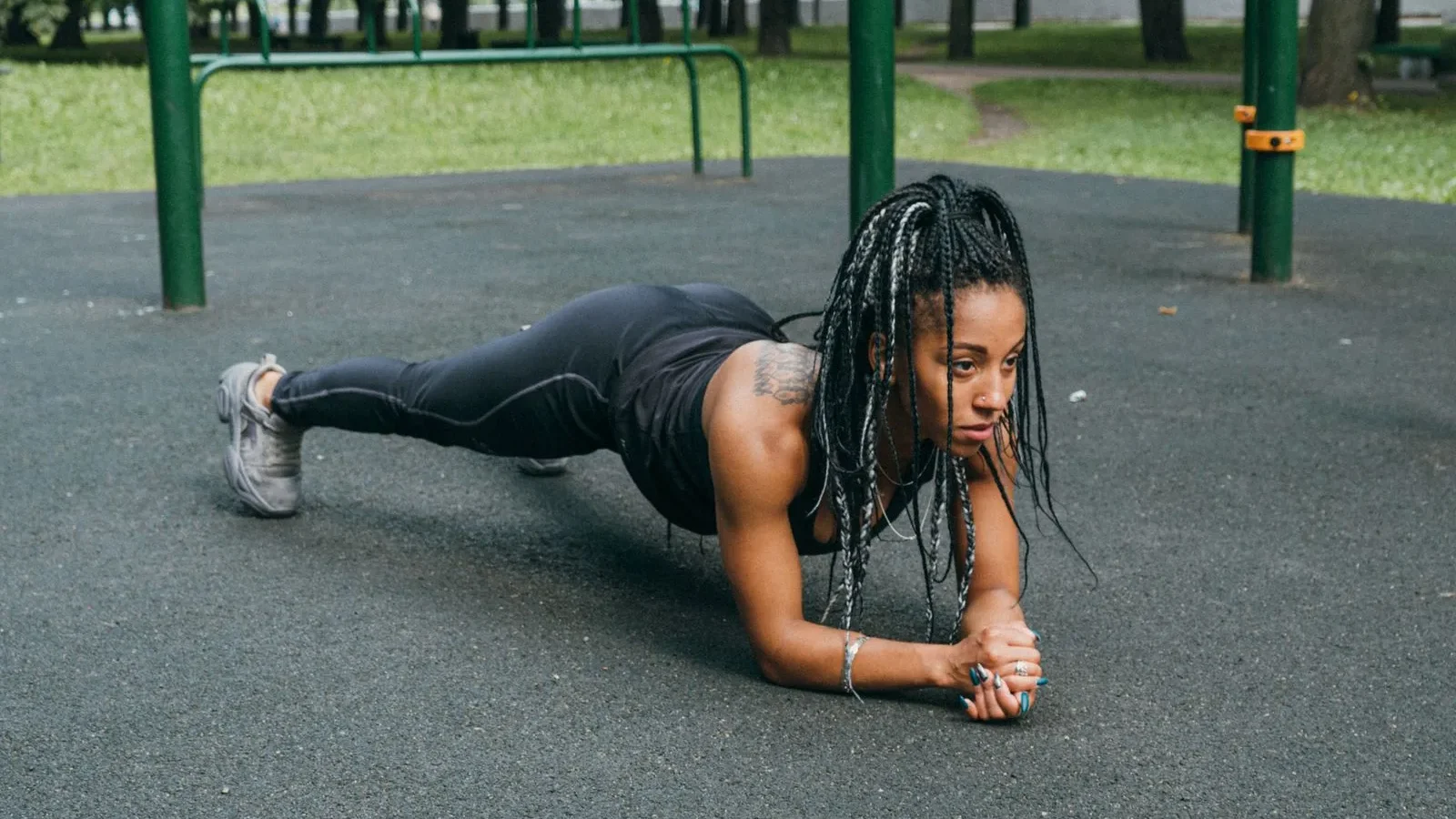
Front plank
Rest on your forearms and toes with your elbows under your shoulders and your body in a straight line from head to heels.
- Cue: Squeeze your glutes and brace as if someone were about to poke your stomach.
- Stop when: Your hips sag or your lower back starts to ache. Drop to your knees to make it easier.
Side plank
Lie on your side, prop yourself on one forearm with the elbow under your shoulder, and lift your hips until your body forms a straight line.
- Cue: Push the floor away and keep your hips stacked rather than rolling back.
- Easier: Keep your bottom knee on the floor.
Bird dog
Start on your hands and knees. Reach one arm forward and the opposite leg back until both are level with your body, pause, then return and switch.
- Cue: Picture a glass of water balanced on your lower back. Keep your hips level and don’t arch.
- Harder: Hold each rep for 3 to 5 seconds.
Pallof press
Anchor a resistance band at chest height and stand side-on to it. Hold the band at your chest with both hands, press it straight out, hold for 2 seconds, then bring it back.
- Cue: Don’t let the band twist you. Keep your shoulders and hips facing forward.
- Harder: Step farther from the anchor or use a stronger band.
| Exercise | Main job | Start with | Progress to |
|---|---|---|---|
| Dead bug | Resists arching | 2 sets of 6–8 per side | Slower reps, straighter legs |
| Curl-up | Trunk flexion endurance | 2 sets of 6–8, 5-second holds | Longer holds, elbows lifted |
| Front plank | Resists arching | 2 holds of 20–30 seconds | 45–60 seconds, or one foot lifted |
| Side plank | Resists side bending | 2 holds of 15–20 seconds per side | Feet stacked, 30–45 seconds |
| Bird dog | Resists rotation and arching | 2 sets of 6–8 per side | Longer pauses |
| Pallof press | Resists rotation | 2 sets of 8–10 per side | Stronger band, more distance |
A 10-minute core routine
Do this 2 or 3 times a week, after a strength session or on its own. Go through the circuit twice, resting about 15 seconds between exercises and 30 seconds between rounds.
- Dead bug: 30 seconds, alternating sides
- Front plank: 30 seconds
- Side plank: 20 seconds on each side
- Bird dog: 30 seconds, alternating sides
- Curl-up: 30 seconds of slow reps with short holds
- Pallof press: 20 seconds on each side
Once the routine feels easy with good form, add 5 to 10 seconds to each exercise or a third round. Stop any set when your form slips; quality matters more than burning out.
What a week looks like in practice
Monday and Thursday: a full-body strength session with this routine as the finisher. Tuesday, Wednesday, Friday and Saturday: a 30- to 40-minute brisk walk. Sunday: rest. That covers the CDC’s two strength days and adds up to 120 to 160 minutes of moderate activity, close to its 150-minute weekly target. Our walking for weight loss guide shows how to build up the walks.
What actually reduces belly fat
Belly fat shrinks as part of overall fat loss. These habits have the strongest evidence behind them.
A moderate calorie deficit
The CDC notes that most weight loss comes from eating and drinking fewer calories. A modest daily deficit is usually easier to live with than a crash diet. See how a calorie deficit works to set yours.
Regular aerobic exercise
A 2013 meta-analysis of 15 studies with 852 participants found that exercise reduced visceral fat, the deeper fat around the organs, in adults with overweight even without a calorie-restricted diet. Moderate- or high-intensity aerobic training showed the most potential.
Full-body strength training
A 2022 meta-analysis of randomized trials in healthy adults found that full-body resistance training reduced body fat percentage, fat mass and visceral fat compared with no exercise. Enough protein supports that work; see how much protein you need to lose weight.
For the full plan, including food swaps, sleep and how to measure your waist, read our guide on how to lose belly fat.
Common core-training mistakes
- Chasing hundreds of crunches. High reps build endurance, not fat loss. Spend extra time walking or on full-body strength work instead.
- Pulling on your neck. Let your trunk do the lifting, and keep your hands as support.
- Holding your breath. Brace your midsection and keep breathing steadily.
- Letting your hips sag in a plank. A shorter hold with good form beats a long one with your lower back arched.
- Training abs daily and skipping legs and back. Your core is one of several major muscle groups, not the whole program.
- Buying gadgets or fat burners to target belly fat. Nothing spot-reduces. Read how fat burners actually work before spending money.