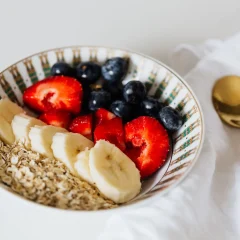
To avoid overeating after workouts, plan what you’ll eat before you train, make it a protein-rich snack or your next regular meal, and don’t treat the calories on your watch as a budget to spend. A single workout usually doesn’t make people eat more right away, but over weeks some people quietly eat back part of what they burn.
This guide covers what the research says about exercise and appetite, how many calories common workouts really burn compared with common snacks, why fitness trackers can mislead you, and which post-workout snacks give you protein without undoing your effort.
The aim isn’t to ignore hunger after exercise. It’s to answer it with a plan instead of a reward.
Does exercise make you hungrier?
For most people, not right away. Lab studies consistently find that a single workout doesn’t trigger a big rebound in eating over the next few hours.
That’s reassuring, but it isn’t the full story. The bigger issue tends to show up over weeks and months, and it varies a lot from person to person.
Why some people eat back their workouts
Researchers call it compensation: weight loss from an exercise program ends up smaller than the extra calories burned would predict. Two well-known studies show how it plays out.
The E-MECHANIC team also looked at who compensated most. Those people reported bigger increases in appetite and in cravings for sweet foods. They also reported a stronger belief that healthy behaviors can make up for unhealthy ones, the classic “I earned this” mindset.
So the problem usually isn’t one post-gym snack. It’s a small daily drift in eating, often driven by hunger, cravings and the feeling that exercise entitles you to extra food.
How many calories workouts really burn
Most people overestimate how much a workout burns. The 2024 Adult Compendium of Physical Activities, a research reference that lists the energy cost of more than 1,100 activities in METs, is a good reality check.
One MET is roughly the energy you use sitting quietly, about 1 calorie per kilogram of body weight per hour. Using the Compendium’s own conversion formula, here are estimates for 30 minutes of common workouts at two body weights.
| Activity (30 minutes) | METs (2024 Compendium) | 154 lb (70 kg) | 198 lb (90 kg) |
|---|---|---|---|
| Walking, 2.8 to 3.4 mph, moderate pace | 3.8 | About 140 calories | About 180 calories |
| Walking, 3.5 to 3.9 mph, brisk | 4.8 | About 175 calories | About 225 calories |
| Weight training, multiple exercises, 8 to 15 reps | 3.5 | About 130 calories | About 165 calories |
| Elliptical trainer, moderate effort | 5.0 | About 185 calories | About 235 calories |
| Stationary bike, general | 6.8 | About 250 calories | About 320 calories |
| Running, 6 to 6.3 mph (10-minute mile) | 9.3 | About 340 calories | About 440 calories |
Two caveats matter. First, these totals include the energy you would have burned anyway just sitting, so the extra burn is roughly 35 to 50 calories lower, depending on body weight. Second, the Compendium’s own team notes it wasn’t built to give precise numbers for an individual. Age, sex, body size and effort all shift the real figure.
Calories scale with body weight, so heavier people burn more for the same activity. For your overall daily needs, including activity, try our TDEE calculator.
Workouts vs. snacks: the math
Here’s how long a 154-lb (70 kg) person would need to exercise to match some common snacks, using the same Compendium values and calorie counts from USDA FoodData Central.
| Snack (USDA) | Calories | Moderate walking to match | Running at 6 mph to match |
|---|---|---|---|
| Blueberry muffin, medium (113 g) | About 424 | About 90 minutes | About 37 minutes |
| Glazed doughnut, medium (60 g) | About 253 | About 55 minutes | About 22 minutes |
| Potato chips, 1 oz (28 g) | About 150 | About 32 minutes | About 13 minutes |
Because these workout estimates include resting energy, the real match takes a little longer. The point isn’t that treats are off-limits. It’s that a “reward” snack can easily cancel a whole session, which is why the habit matters more than any single choice.
Exercise still has benefits that go well beyond calories burned. Our guide to the top workouts to burn fat covers how to build a routine.
Why your fitness tracker’s calorie count can mislead
If you eat back the calories your watch says you burned, you’re trusting a number that may be well off.
A tracker is still useful for spotting trends, such as whether you’re moving more this month than last. Just treat its calorie figure as a rough estimate, not a budget you need to spend.
Smart post-workout snacks
If you’re hungry after training, or your next meal is hours away, a planned snack with protein is a better answer than whatever is closest. Protein won’t cancel hunger, but a 2015 review found that higher-protein meals have a modest effect on fullness, and it suggested at least about 25 to 30 g of protein per meal.
These options give you protein for a moderate number of calories. Values are from USDA FoodData Central and rounded.
| Snack | Serving | Calories | Protein |
|---|---|---|---|
| Plain nonfat Greek yogurt with a banana | 170 g container plus 1 medium banana (118 g) | About 205 | About 19 g |
| Light tuna in water on whole-wheat bread | 3 oz drained (85 g) on 1 slice (32 g) | About 155 | About 20 g |
| Edamame, cooked from frozen | 1 cup (155 g) | About 190 | About 18 g, plus 8 g fiber |
| Hard-boiled eggs | 2 large (100 g) | About 155 | About 13 g |
| Cottage cheese, lowfat (2%) | 1/2 cup (113 g) | About 90 | About 12 g |
| Lowfat chocolate milk | 1 cup (250 g) | About 160 | About 9 g |
The key is that the snack replaces something rather than adding on. If dinner is an hour away, you may not need a snack at all. To see how protein fits your whole day, read our guide to how much protein you need to lose weight.
A simple plan for after your workout
- Decide before you train. Know whether you’ll eat a snack or go straight to your next meal, so the choice isn’t made while you’re tired and hungry.
- Pack it. Bring the snack with you so the café or vending machine isn’t your only option.
- Time workouts before meals when you can. Then your regular meal does double duty as recovery food.
- Drop the “I earned it” story. Exercise is something you do for your health, not a ticket for extra food.
- Use your tracker for trends, not calories. Base your intake on your planned daily target, not on what your watch says you burned.
- Check in after a few weeks. If your weight hasn’t moved and you’re hungrier than usual, look at snacks and portions first.
What this looks like in practice
Say you walk briskly for 45 minutes at 5:30 p.m. and dinner is at 7. Using the table above, that walk burns roughly 265 calories at 154 lb. Instead of stopping for a pastry on the way home, you drink water, shower and sit down to a dinner built around a palm-sized portion of protein and plenty of vegetables. If you train at 6 a.m. and lunch is hours away, Greek yogurt with a banana makes a planned, protein-rich breakfast instead.
If weight loss is your goal, exercise works best alongside a modest calorie deficit. Our guide to how a calorie deficit works explains how to set one without extreme restriction.