The best diet and supplement combo for 2026 is simpler than most supplement ads suggest. Get the diet right first: a sensible calorie target, enough protein, plenty of fiber and fluids. Then, if you train, add a short list of supplements with solid evidence behind them.
For most people that list is protein powder (for convenience) and creatine monohydrate (if you lift), with caffeine as an optional training aid. Omega-3s and a multivitamin only earn a place when your diet has a specific gap.
Below you’ll find the diet foundation, what the research says about each supplement, a sample day, a beginner and intermediate stack table, and who should check with a doctor first.
Build the diet first: four targets that matter
No supplement can make up for a diet that doesn’t fit your goal. Before buying anything, set these four targets and hit them most days for a few weeks.
| Target | Sensible starting point | Easy way to hit it |
|---|---|---|
| Calories | About 300–500 calories a day below maintenance for fat loss | Estimate maintenance with a TDEE calculator, then log food for 2–3 weeks |
| Protein | About 1.2–1.6 g per kg of body weight a day (0.55–0.75 g per lb), or about 1.6–2.2 g/kg if you strength train | A protein source at every meal, roughly 25–40 g each |
| Fiber | Vegetables or fruit at most meals, plus beans, lentils, oats or whole grains | Fill half your plate with vegetables; add beans to soups and salads |
| Fluids | Regular drinks through the day, more in heat or when you sweat a lot | Water with each meal and a bottle nearby when training |
The calorie target drives fat loss; our guide to how a calorie deficit works explains how to set it. Protein comes next.
A 2015 review in the American Journal of Clinical Nutrition found that higher-protein, calorie-restricted diets produced more fat loss and better preservation of lean mass than lower-protein versions in tightly controlled studies. It suggested 1.2–1.6 g/kg a day, with at least 25–30 g per meal. Our guide to how much protein you need to lose weight shows how to get there with food.
Training is the other half of the foundation. Two to four strength sessions a week, plus regular walking, give the supplements below something to support.
Why supplements come second
Supplements are regulated far more lightly than medicines. The FDA states that it does not have the authority to approve dietary supplements before they are marketed, and companies generally don’t have to give the agency the evidence they rely on for safety (new ingredients are an exception).
That means a label is only as reliable as the company behind it. The NIH Office of Dietary Supplements (ODS) points to third-party programs such as NSF Certified for Sport, Informed-Choice and the Banned Substances Control Group, which check that products contain the labeled amounts and are free of many banned substances.
Protein powder: the most practical add-on
Protein powder isn’t special. It is simply a convenient way to reach your daily protein target when meals fall short, which is common when you’re eating less.
A 2018 meta-analysis in the British Journal of Sports Medicine pooled 49 randomized trials with 1,863 participants who did resistance training for at least six weeks. Protein supplements modestly increased gains in strength and muscle mass, but protein beyond a total intake of about 1.6 g/kg a day added no further muscle gain.
So if your food already gets you to your target, a shake adds little. If you’re consistently short, one scoop a day is an easy fix.
What to check on the label
- Protein and calories per scoop, so you know exactly what you’re adding.
- Protein type: whey or casein from dairy, or soy and pea blends if you avoid dairy. The ODS notes that whey contains more leucine than casein or soy.
- A third-party seal such as NSF Certified for Sport or Informed-Choice.
- Allergens and sweeteners you know don’t agree with you.
Formulas change, so check the current label rather than relying on an old review.
Creatine monohydrate: the best-studied training supplement
Creatine helps your muscles regenerate energy (ATP) for short, intense efforts like lifting and sprinting. The ODS describes it as one of the most thoroughly studied and widely used supplements for exercise performance.
The International Society of Sports Nutrition’s 2017 position stand concludes that creatine consistently improves high-intensity exercise performance and training adaptations, and that both short- and long-term use is safe and well tolerated in healthy people.
How it’s typically used
- Simple approach: 3–5 g a day, every day. The ODS notes that about 3–6 g a day for 3–4 weeks, without a loading phase, produces performance benefits.
- Faster approach: 20 g a day split into four 5 g doses for 5–7 days, then 3–5 g a day.
- Form: plain creatine monohydrate. According to the ODS, pricier forms haven’t been shown to work better.
Expect the scale to go up a little. The ODS reports that several studies found a 1–2 kg (about 2–4 lb) gain in body weight in the first month of use with strength training, largely from water held in muscle. Track your waist and strength as well as your weight.
Creatine is not a fat burner; its role is to support your training. If you have kidney disease, are pregnant or are under 18, ask your doctor before using it.
Caffeine and pre-workouts: helpful, with limits
Caffeine is the main proven ingredient in most pre-workouts. The ISSN’s 2021 position stand found that 3–6 mg per kg of body weight improves many kinds of exercise performance in many, though not all, studies, usually taken about 60 minutes before training. Very high doses (around 9 mg/kg) bring more side effects without a clear extra benefit.
For a 70 kg (154 lb) person, 3–6 mg/kg works out to about 210–420 mg. That is already close to the FDA’s reference point: for most adults, 400 mg a day from all sources is not generally associated with negative effects.
So count everything: coffee, tea, energy drinks and the pre-workout scoop. For many people, a cup of coffee before training does the job.
Pre-workout label checklist
- Caffeine listed in milligrams per serving. Avoid proprietary blends that hide amounts.
- Start with half a serving to judge your tolerance.
- Beta-alanine, a common ingredient, can cause tingling skin (paresthesia).
- Never use pure powdered caffeine. The FDA warns that around 1,200 mg taken quickly, less than half a teaspoon of pure caffeine, can cause toxic effects such as seizures.
- Stop caffeine several hours before bed so it doesn’t cut into your sleep.
Skip caffeine-heavy products if you have a heart rhythm problem, high blood pressure or anxiety, or are under 18. If you’re pregnant, trying to conceive or breastfeeding, ask your provider about caffeine limits. If stimulants don’t suit you, see our guide to stim-free pre-workouts.
Omega-3s and multivitamins: only for specific gaps
Omega-3 (fish or algae oil)
The ODS notes that official intake recommendations exist only for ALA, the plant omega-3 (1.6 g a day for men and 1.1 g for women); there are no specific targets for EPA and DHA, the omega-3s in fish oil. Fatty fish such as salmon, mackerel, tuna, herring and sardines are rich sources of both.
If you eat fatty fish regularly, a supplement is optional. If you rarely eat fish or follow a vegan diet, fish oil or algae oil is a reasonable way to fill the gap. Treat it as general nutrition, not a fat-loss aid.
Doses vary widely: the ODS says a typical 1,000 mg fish oil capsule provides about 180 mg EPA and 120 mg DHA. Side effects are usually mild, such as an unpleasant taste, heartburn or nausea. If you take warfarin or another blood thinner, talk to your doctor first.
Multivitamin
A multivitamin isn’t a fat-loss or performance supplement. It is a reasonable safety net if your diet is restricted, for example if you’re eating much less than usual, cutting out food groups or following a vegan diet.
Choose one that stays close to 100% of the Daily Value for most nutrients rather than megadoses, and don’t double up with other products that repeat the same vitamins and minerals. If you suspect low iron or vitamin D, ask your doctor about a blood test rather than guessing.
What to skip
- Fat burners and “metabolism boosters.” They can’t replace a calorie deficit, and stimulant-heavy blends add risk. Here’s how fat burners actually work.
- Proprietary blends that hide how much of each ingredient you’re getting.
- Hormone “boosters” and adaptogen stacks. We left these out because their evidence and safety picture is much less clear than for the supplements above.
- Anything promising fast or effortless weight loss. That is a marketing claim, not a result.
Your stack by level: beginner and intermediate
Start with the fewest products that solve a real problem. Add one at a time, and give each several weeks before judging it.
| Supplement | Beginner | Intermediate | Typical amount | Main caution |
|---|---|---|---|---|
| Protein powder | Only if you’re short of your protein target | Same; handy on busy or training days | Enough to close your daily gap, often one scoop | Allergens; count its calories |
| Creatine monohydrate | Yes, if you strength train | Yes | 3–5 g a day | 1–2 kg early water weight; ask a doctor if you have kidney disease |
| Caffeine (coffee or pre-workout) | Not needed; coffee is fine | Optional before hard sessions | Low end of 3–6 mg/kg, about 60 minutes before; total within 400 mg a day | Sleep, anxiety, heart conditions, pregnancy |
| Omega-3 (fish or algae oil) | Only if you rarely eat fatty fish | Same | As labeled; check EPA and DHA per serving | Blood thinners |
| Multivitamin | Only if your diet is restricted | Same | One a day, near 100% of the Daily Value | Doubling up with other supplements |
A sample day: what this looks like in practice
Here is how the combo fits into a day for a 75 kg (165 lb) person who lifts three times a week and is aiming for about 120 g of protein (1.6 g/kg).
- Breakfast: Greek yogurt with oats and berries, plus coffee. Aim for about 30 g of protein.
- Lunch: A chicken or lentil grain bowl with plenty of vegetables. Aim for about 30 g of protein.
- Before training: No extra caffeine if you had coffee earlier; otherwise half a serving of pre-workout about an hour before.
- After training: A protein shake and a piece of fruit, with 3–5 g of creatine stirred in. Aim for 25–40 g of protein.
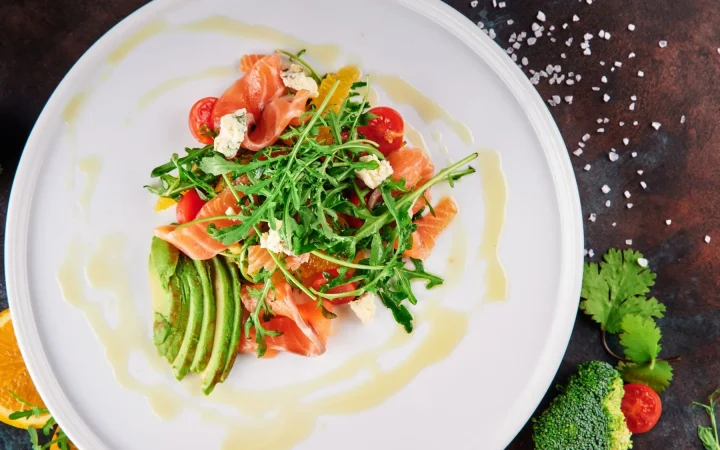
- Dinner: Salmon, potatoes and roasted vegetables. Aim for about 30 g of protein; the fish also covers omega-3s.
Take creatine at whatever time you’ll remember, including rest days; the studied protocols are simply daily doses. Check labels to see how close each meal gets you to its protein goal.
Who should check with a doctor first
Review your plan every four weeks. If your waist, weight and training are moving in the right direction, keep going. If not, adjust calories or training first; changing supplements is rarely the fix.