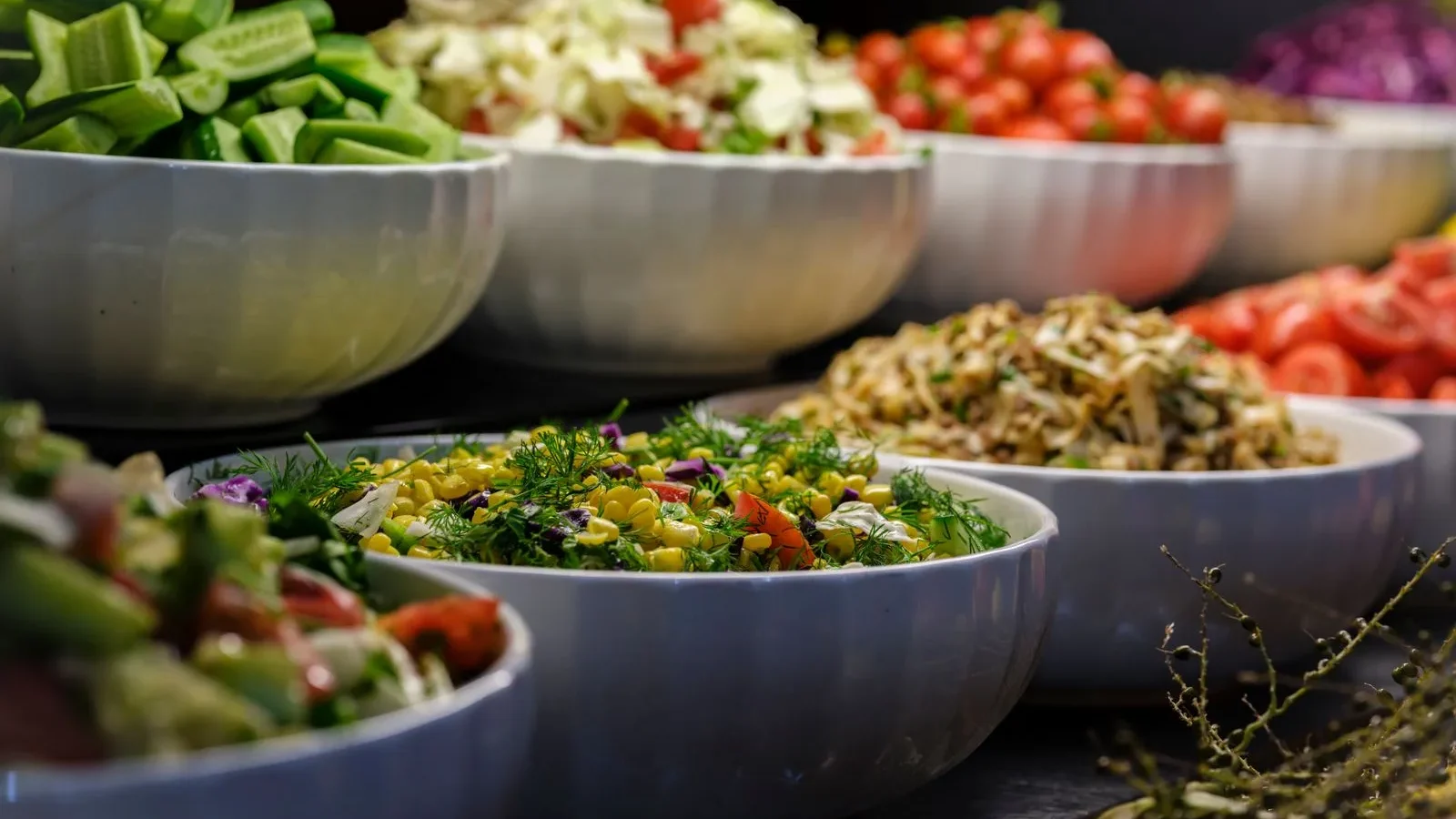
The most useful lower-calorie foods aren’t diet products. They’re everyday foods that give you a big, satisfying portion for relatively few calories: watery vegetables and fruit, broth-based soups, potatoes and oats, beans, and lean proteins like fish, eggs and plain yogurt.
The idea behind this is called energy density, or how many calories a food packs into each gram. This guide explains it in plain terms, lists filling foods with calorie counts from USDA FoodData Central (with serving sizes), and shows how to build them into real meals.
Nothing here is off-limits. The goal is to fill most of your plate with foods that let you eat well and still stay within your calorie needs.
Why some foods fill you up on fewer calories
Energy density is simply calories per gram of food. Water adds weight and volume but no calories, while fat carries about 9 calories per gram, so foods rich in water tend to be low in energy density and fatty foods tend to be high.
This matters because of how people eat. In a review of the research, nutrition scientist Barbara Rolls notes that people tend to eat a fairly consistent weight of food, so when the foods available are lower in energy density, they take in fewer calories.
USDA numbers show how wide the range is. All of these are per 100 grams (about 3.5 ounces):
| Food (100 g) | Calories (USDA) | What drives it |
|---|---|---|
| Cucumber, with peel, raw | 15 | About 95% water |
| Watermelon, raw | 30 | About 91% water |
| Potato, boiled in skin | 87 | Water plus starch |
| Chicken breast, roasted | 165 | Mostly protein and water |
| Raisins, dark | 299 | Grapes with most water removed |
| Almonds | 579 | About 50% fat, little water |
| Olive oil | 884 | Pure fat |
The grape-and-raisin pair makes the point well. According to USDA data, a cup of grapes (151 g) has about 104 calories, while a cup of raisins (145 g) has about 434. Same fruit, but drying it shrinks the volume and concentrates the calories.
What the research says about eating more volume
Energy density isn’t just a lab curiosity. It has been tested in longer trials and in simple meal experiments.
Starting with salad or soup
Eating a low-calorie first course can trim the meal that follows. In one study, 42 women ate a required salad before a pasta lunch. Compared with no salad, a light salad cut total meal calories by 7% (small portion) to 12% (large portion).
The catch: when the salad was made calorie-dense with more dressing and cheese, total meal intake went up by 8% to 17%. What you add to a salad matters.
Soup worked in a similar way. In a study of 60 normal-weight adults, eating vegetable soup before lunch reduced total meal calories by about 20%, or 134 calories, compared with no soup. Whether the soup was chunky, pureed or served as broth and vegetables separately made no significant difference.
Which foods feel most filling
A 1995 study fed groups of 11 to 13 people 240-calorie portions of 38 common foods and tracked fullness for two hours. Boiled potatoes scored highest, about seven times more filling than the lowest-scoring croissant. Foods higher in protein, fiber and water tended to score higher, and higher-fat foods lower.
The study was short and the groups were small, but its pattern fits the energy-density research.
Vegetables: the biggest portions for the fewest calories
Most vegetables are so low in energy density that you can eat large amounts. Values are from USDA FoodData Central.
| Vegetable | Serving | Calories |
|---|---|---|
| Celery, raw | 1 medium stalk (40 g) | About 6 |
| Spinach, raw | 1 cup (30 g) | About 7 |
| Romaine lettuce, raw | 1 cup shredded (47 g) | About 8 |
| Zucchini, raw | 1 cup chopped (124 g) | About 21 |
| White mushrooms, raw | 1 cup whole (96 g) | About 21 |
| Carrot, raw | 1 medium (61 g) | About 25 |
| Broccoli, boiled | ½ cup chopped (78 g) | About 27 |
| Cauliflower, raw | 1 cup chopped (107 g) | About 27 |
| Cherry tomatoes | 1 cup (149 g) | About 27 |
| Red bell pepper, raw | 1 medium (119 g) | About 31 |
| Cucumber, with peel | 1 whole, about 8 inches (301 g) | About 45 |
Cooking methods change the picture. Roasting vegetables in a generous pour of oil can add more calories than the vegetables themselves, so measure the oil.
Fruits that satisfy a sweet tooth
Whole fruit brings water and fiber along with its natural sugar, so you get a bigger portion to chew through than the same calories from juice or dried fruit.
| Fruit | Serving | Calories |
|---|---|---|
| Watermelon | 1 cup diced (152 g) | About 46 |
| Strawberries | 1 cup halves (152 g) | About 49 |
| Cantaloupe | 1 cup cubes (160 g) | About 54 |
| Orange | 1 fruit, about 2⅝ inches (131 g) | About 62 |
| Blueberries | 1 cup (148 g) | About 84 |
| Apple, with skin | 1 medium, 3 inches (182 g) | About 95 |
| Grapes | 1 cup (151 g) | About 104 |
Filling proteins and starches
Proteins and starchy foods are higher in calories per bite than vegetables, but many are still moderate in energy density and very satisfying. Protein-rich foods also scored as more filling in the satiety study above; see how much protein you need to lose weight.
| Food | Serving | Calories | Why it helps |
|---|---|---|---|
| Popcorn, air-popped | 1 cup (8 g) | About 31 | Lots of volume per calorie |
| Egg, hard-boiled | 1 large (50 g) | About 78 | About 6 g protein |
| Cottage cheese, 1% fat | 4 oz (113 g) | About 81 | About 14 g protein |
| Shrimp, cooked | 3 oz (85 g) | About 84 | About 20 g protein |
| Cod, cooked | 3 oz (85 g) | About 89 | About 19 g protein |
| Greek yogurt, plain nonfat | 1 container (170 g) | About 100 | About 17 g protein |
| Potato, boiled in skin | 1 potato, 2½ inches (136 g) | About 118 | Topped the satiety index |
| Chicken breast, roasted | ½ breast (86 g) | About 142 | About 27 g protein |
| Oatmeal, cooked with water | 1 cup (234 g) | About 166 | Absorbs water as it cooks |
| Black beans, boiled | 1 cup (172 g) | About 227 | About 15 g fiber |
| Lentils, boiled | 1 cup (198 g) | About 230 | About 16 g fiber |
Beans and lentils look high on this list, but a cup brings protein and about 15 g of fiber, so a half cup in a salad or soup goes a long way. For more on eggs, see how many grams of protein are in an egg.
Calorie-dense foods to measure, not ban
Some of the most nutritious foods are also the most energy-dense. Nuts and olive oil are good examples. They belong in a healthy diet; they just need a measured portion.
| Food | Serving | Calories |
|---|---|---|
| Olive oil | 1 tablespoon (13.5 g) | About 119 |
| Potato chips, plain | 1 oz, about 22 chips (28 g) | About 149 |
| Almonds | 1 oz, about 23 nuts (28 g) | About 164 |
| Peanut butter, smooth | 2 tablespoons (32 g) | About 191 |
| Raisins | 1 cup, not packed (145 g) | About 434 |
How to use lower-calorie foods in your meals
You don’t need a new diet, just a few swaps that add volume. These ideas come straight from the research above:
- Start with soup or salad. A broth-based soup or a big salad with a light dressing before your main course can take the edge off hunger.
- Go half-and-half on pasta and rice. Mix your usual starch with vegetables so the bowl stays full.
- Bulk up breakfast. Add berries or chopped fruit to oatmeal or yogurt.
- Snack on volume. Three cups of air-popped popcorn have about 93 calories; a 1-ounce bag of chips has about 149.
- Choose whole fruit over dried fruit or juice when you want something sweet.
- Measure the extras. Oil, dressing, cheese and nut butter are where calories hide.
Worked example: a lighter pasta bowl
A cup of cooked spaghetti has about 196 calories. Swap half of it for chopped zucchini and the bowl drops to about 119 calories (roughly 98 for a half cup of pasta plus 21 for the zucchini), while holding more food.
Air-popped popcorn is one of the easiest high-volume snacks to make at home if you eat it often.
A sample day built on energy density
Here is how these foods fit together, using the USDA figures above. Treat it as a template: calorie needs vary with body size, age and activity.
| Meal | What’s in it | About |
|---|---|---|
| Breakfast | 1 cup oatmeal cooked with water, 1 cup strawberries, 1 container plain nonfat Greek yogurt | 315 calories |
| Lunch | 2 cups romaine, 1 cup cherry tomatoes, half a cucumber, 3 oz shrimp, ½ cup black beans, 1 tablespoon olive oil | 380 calories |
| Snack | 1 medium apple, 4 oz 1% cottage cheese, 1 oz almonds | 340 calories |
| Dinner | 3 oz cod, 1 boiled potato (2½ inches), 1 cup boiled broccoli, 1 teaspoon olive oil | 300 calories |
| Evening | 3 cups air-popped popcorn | 93 calories |
That adds up to roughly 1,430 calories, with plenty of food at every meal. It shows how these foods fit together; it isn’t a calorie target. If your needs are higher, add more oats, beans, potatoes or fruit rather than reaching for calorie-dense extras. Our guide to how a calorie deficit works explains how to find the right target.