The simplest workouts for weight loss are the ones a beginner can repeat most weeks without getting hurt: brisk walking, a short bodyweight circuit and a basic strength routine twice a week. You can do all three at home or around your neighborhood with little or no equipment.
One honest caveat up front: exercise on its own usually brings modest weight loss. What you eat does most of the work on the scale, while these workouts add to your calorie deficit, help you keep muscle and improve your health in ways the scale can’t show.
Below you’ll find what the research says, a six-week walking progression, two beginner routines with form cues, a sample week and the mistakes that most often derail new exercisers.
What exercise can and can’t do for weight loss
Most people overestimate how much a workout burns. Studies of exercise-only programs keep finding the same pattern: real but small changes on the scale.
The American College of Sports Medicine (ACSM) reached a similar view in its position stand. It found that 150 to 250 minutes a week of moderate activity brings only modest weight loss by itself, while more than 250 minutes a week has been linked with clinically significant loss. The 150 to 250 minute range did improve results when people also cut calories moderately.
The CDC puts it plainly: most weight loss comes from decreasing calories, and losing weight and keeping it off takes a high amount of activity unless you also adjust your diet. That’s why these workouts work best alongside a moderate calorie deficit.
Exercise still earns its place. The ACSM review notes that endurance or resistance training improves health risks even without weight loss, and that resistance training may increase lean mass while you lose fat.
Start with a six-week walking progression
Walking is the easiest place to start. It needs only supportive shoes, it’s gentle on the joints, and the CDC uses brisk walking as its main example of moderate-intensity activity.
Aim for a pace where you can talk but not sing, which is the CDC’s rule of thumb for moderate effort. On a 0-to-10 effort scale, that’s about a 5 or 6.
| Week | Walks per week | Time per walk | Weekly total | Focus |
|---|---|---|---|---|
| 1 | 5 | 10 min | 50 min | Comfortable pace; build the habit |
| 2 | 5 | 15 min | 75 min | Same pace, a little longer |
| 3 | 5 | 20 min | 100 min | Make the last 5 minutes brisk |
| 4 | 5 | 25 min | 125 min | Make the middle 10 minutes brisk |
| 5 | 5 | 30 min | 150 min | Mostly brisk; this meets the CDC’s 150-minute weekly target |
| 6 | 5 | 30 min | 150 min | Add a gentle hill or a few 1-minute faster stretches |
If 10 minutes feels like a lot, start with 5 and repeat any week before moving up. Short walks still count: a 2019 meta-analysis of 19 studies with 1,080 adults found that splitting exercise into several shorter bouts a day gave similar benefits for fitness, blood pressure and blood fats as one continuous session of the same total length.
Walking form cues
- Stand tall with your eyes ahead, not down at your feet or phone.
- Let your arms swing naturally from the shoulders, and bend your elbows a little as you speed up.
- To go faster, take quicker steps rather than longer ones, landing on your heel and rolling through to your toes.
- Pick even, well-lit routes while you build up, and wear comfortable, supportive shoes.
For step goals and more walking plans, see our walking for weight loss guide.
Add a 20-minute bodyweight circuit
This circuit needs only your body weight, a wall and a sturdy chair. Warm up for 5 minutes with marching in place, arm circles and a few easy sit-to-stands.
Then do each move once in order, rest 30 to 60 seconds after the last one, and repeat the round two or three times.
| Move | Beginner dose | Form cues | Easier / harder |
|---|---|---|---|
| Chair squat (sit-to-stand) | 8–12 reps | Feet hip-width, chest up, hips back, knees in line with toes; stand by pressing through your whole foot | Higher seat / lower slowly over 3 seconds |
| Wall or counter push-up | 8–12 reps | Body in one straight line from head to heels; elbows angled slightly toward your sides, not flared straight out | Stand closer to the wall / use a lower, sturdy surface |
| Glute bridge | 10–12 reps | On your back, knees bent; press through your heels and squeeze your glutes until hips line up with knees and shoulders, without arching your lower back | Smaller range / pause 2 seconds at the top |
| Supported reverse lunge | 6–8 per side | Hold a chair, step one foot back and bend both knees; keep the front knee over the middle of the foot | Shorter step and shallower bend / no hand support |
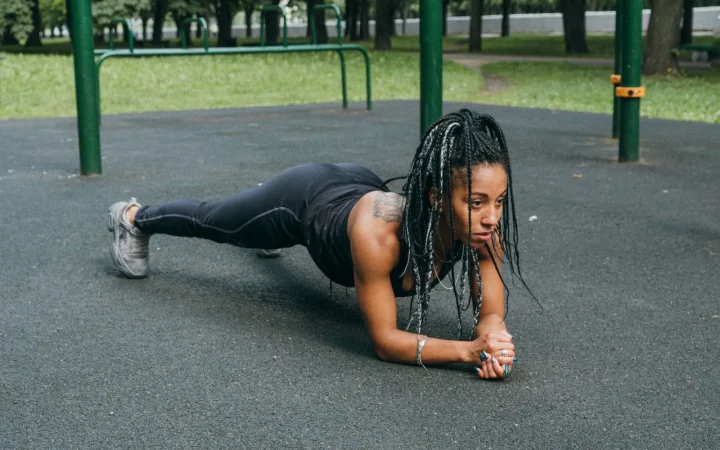
| Bird dog | 6 per side | On hands and knees, reach the opposite arm and leg long while keeping your hips level and back flat | Move only an arm or a leg / hold each rep 3 seconds |
| March or step jacks | 30–45 seconds | Stay light on your feet and keep breathing steadily | Slower march / quicker pace with overhead reaches |
Finish each set while you could still do two or three more good reps. Sharp pain, dizziness or pain inside a joint means stop for the day, not push through.
Build strength with bands or dumbbells
The CDC recommends muscle-strengthening activity at least 2 days a week that works all the major muscle groups: legs, hips, back, abdomen, chest, shoulders and arms. This routine covers them in about 25 to 30 minutes.
Strength work matters during weight loss. A 2022 meta-analysis of 54 randomized trials in healthy adults found that full-body resistance training for at least 4 weeks, compared with no exercise, lowered body fat by about 1.5 percentage points and fat mass by about 0.55 kg (1.2 lb). It also reduced visceral fat, the deeper fat around the organs.
| Exercise | Sets x reps | Main muscles | Form cues |
|---|---|---|---|
| Goblet squat (one dumbbell) or band squat | 2 x 10–12 | Legs, hips | Hold the weight at your chest, sit back and down, keep heels planted |
| Romanian deadlift (dumbbells or band) | 2 x 10–12 | Hamstrings, glutes, back | Soft knees, push your hips back, keep your back flat and the weight close to your legs |
| Band chest press or incline push-up | 2 x 10–12 | Chest, shoulders, arms | Ribs down, press straight ahead, control the return |
| Band row or one-arm dumbbell row | 2 x 10–12 | Upper back, arms | Pull your elbows back close to your body and squeeze your shoulder blades; don’t shrug |
| Light overhead press | 2 x 8–10 | Shoulders, arms | Brace your abs and press up without leaning back |
| Dead bug or kneeling plank | 2 x 6 per side, or 20–30 seconds | Abdomen | Keep your lower back steady and keep breathing |
Choose a band or dumbbell that lets you finish every rep with good form while the last two or three reps feel hard. When 2 sets of 12 feel easy, add a third set or move up to a slightly heavier weight or stronger band.
Bands are a practical home option because they’re light and take up little space. Check yours for nicks or tears before each session, and follow the maker’s instructions for any door anchor.
Training works best with enough protein to support your muscles; see how much protein you need to lose weight.
A sample beginner week
This week combines all three workouts. Use the walk length from whichever week of the progression you’re on, and swap days to fit your schedule.
| Day | Workout | Time |
|---|---|---|
| Monday | Band or dumbbell strength routine | 25–30 min |
| Tuesday | Walk | 10–30 min |
| Wednesday | Bodyweight circuit, plus a short walk if you feel good | 20–30 min |
| Thursday | Walk | 10–30 min |
| Friday | Band or dumbbell strength routine | 25–30 min |
| Saturday | Longer walk, ideally somewhere you enjoy | 15–40 min |
| Sunday | Rest, or an easy walk and gentle stretching | Optional |
Once you can do the full week comfortably, add walks on Monday and Friday to reach five walks, or make one walk longer.
What this looks like in practice
The CDC estimates that a 154-lb person burns about 140 calories walking at 3.5 mph for 30 minutes and about 110 calories in 30 minutes of light weight lifting. Once you reach five 30-minute walks and two strength sessions a week, that adds up to roughly 900 calories.
That’s a useful contribution, but it’s an estimate, and heavier people burn more while lighter people burn less. It also shows why food choices usually supply most of a deficit. To see your own numbers, try our TDEE calculator.
How to progress without getting hurt
- Change one thing at a time. Add a few minutes to your walks or one set to a strength move, not both in the same week.
- Keep at least one easy or rest day. Recovery days help you show up for the next session.
- Use the talk test. If you can’t say more than a few words without pausing for breath, you’ve moved into vigorous effort, which beginners don’t need yet.
- Expect some muscle soreness, not joint pain. Mild soreness after a new move is common; sharp, joint or worsening pain is a reason to stop and get it checked.
- Step back after a break. If you miss a week or two, restart one stage lower in the walking table.
Common mistakes beginners make
- Doing too much in week one. An all-out start can leave you too sore to keep going. A plan you can repeat for months beats a heroic first week.
- Eating back the calories. Exercise calorie figures are rough estimates, and a post-workout snack can easily cancel them out.
- Skipping strength work. Walking alone is great for health, but the strength routine is what helps you hold on to muscle.
- Rushing reps. Slow, controlled movements make it much easier to keep good form than fast, sloppy ones.
- Judging progress only by the scale. Track your waist, how your clothes fit and how much easier the walks feel. Our guide on how to take body measurements shows you how.