The foods with the strongest evidence for lowering LDL (“bad”) cholesterol are those rich in soluble fiber, such as oats, barley, beans and psyllium, plus nuts, soy, foods with added plant sterols or stanols, and liquid oils used in place of saturated fat. Each one lowers LDL by a modest amount. Eaten together, the effects add up.
This guide shows what each food did in clinical trials, how much people actually ate, what a cholesterol-friendly day looks like, and the habits that quietly cancel out the benefits.
One point before you start: food works alongside medical care, not instead of it. If you’ve been prescribed a statin or another cholesterol medicine, keep taking it, and talk to your doctor before you change anything.
How much can food really lower LDL?
Most single foods lower LDL by a few percent. That sounds small, but it stacks.
Combining foods is where diet makes a bigger difference. A 2018 analysis of the “Portfolio” eating pattern pooled 7 trials in 439 adults with high cholesterol. Adding nuts, plant protein, viscous fiber and plant sterols to a standard cholesterol-lowering diet cut LDL by about 17% more than the standard diet alone.
The certainty of evidence for LDL was rated high, but the trials were few. It’s a strong case for combining foods, not a promise of a specific number for you.
The top cholesterol-lowering foods at a glance
Here is what each food did on average in the trials, and how much people ate to get there. Effects in mg/dL are converted from mmol/L and rounded.
| Food | Daily amount in studies | Average LDL change | Worth knowing |
|---|---|---|---|
| Oats and barley | 3 g or more of beta-glucan (their soluble fiber) | About 0.25 mmol/L (roughly 10 mg/dL) lower | 28 oat trials; no change in HDL or triglycerides |
| Psyllium | Median of about 10 g | About 0.33 mmol/L (roughly 13 mg/dL) lower | 28 trials, 1,924 people; moderate-quality evidence |
| Beans, lentils, chickpeas, peas | About 130 g (roughly 1 serving) | About 0.17 mmol/L (roughly 7 mg/dL) lower | 26 trials; authors call for longer, better studies |
| Tree nuts | Per 1 oz (28 g) serving | About 4.8 mg/dL lower | 61 trials; larger effects at 60 g or more a day |
| Plant sterols and stanols | 0.6 to 3.3 g | 6% to 12% lower | Effect rises up to about 3 g a day |
| Soy protein | Median of 25 g | About 4.8 mg/dL (3% to 4%) lower | Small but fairly consistent |
| Unsaturated oils instead of saturated fat | Swapping butter or fatty meat for oils such as canola | Moderate: about 8 to 15 mg/dL lower | High-certainty evidence |
| Fatty fish | 1 to 2 seafood meals a week | Not mainly an LDL food | Linked to fewer heart problems, especially when it replaces less healthy foods |
Soluble fiber: oats, barley, beans and psyllium
Oats and barley
A 2014 meta-analysis of 28 randomized trials found that at least 3 g a day of oat beta-glucan lowered LDL by about 0.25 mmol/L compared with control diets. HDL and triglycerides didn’t change.
The effect was larger in people who started with higher LDL. Within the range tested (3 to 12.4 g a day, for 2 to 12 weeks), a bigger dose or a longer trial didn’t add much. Oatmeal, oat bran and barley in soups or grain bowls are easy ways in. Check labels for soluble fiber per serving; our guide to choosing a filling, low-sugar cereal shows what else to look for on the box.
Beans, lentils and chickpeas
A 2014 meta-analysis of 26 trials found that diets built around about one serving of pulses a day lowered LDL by about 0.17 mmol/L compared with similar-calorie diets without them. Pulses also bring protein, so they work well as a swap for fatty meat. Our guide to plant protein sources has serving-by-serving numbers.
Psyllium
Psyllium is a fiber supplement made from seed husks. In a 2018 meta-analysis of 28 trials with 1,924 people, a median of about 10 g a day lowered LDL by about 0.33 mmol/L, along with other markers linked to heart risk.
It needs care, though. MedlinePlus says to mix the powder with at least 8 ounces of liquid, not to take it for longer than a week unless your doctor says so, and to keep certain medicines, including digoxin and aspirin, at least 3 hours apart from it. Using psyllium for cholesterol is something to set up with your doctor.
Nuts, soy and plant sterols
Nuts
A 2015 meta-analysis of 61 trials with 2,582 adults found that each daily 1-ounce serving of tree nuts lowered LDL by about 4.8 mg/dL. The type of nut mattered less than the amount. Larger effects showed up at 60 g or more a day.
That amount comes with a lot of calories. An ounce of almonds (about 23 nuts) has roughly 164 calories, according to USDA data. Eat nuts in place of other snacks rather than on top of them.
Soy
In 2017 the FDA proposed revoking soy’s heart-health claim over doubts about how consistent the evidence was, and no final decision had been made when this 2019 analysis appeared. A 2019 analysis of the trials the FDA reviewed found that a median of 25 g of soy protein a day, over a median of 6 weeks, lowered LDL by about 4.8 mg/dL, or 3% to 4%. Most individual trials pointed the same way, but only a minority were statistically significant on their own. One coauthor listed an affiliation with the Soy Nutrition Institute.
For scale, half a cup of firm tofu made with calcium sulfate has about 22 g of protein (USDA). Tofu, edamame and soy milk are easy swaps for fatty meat or full-fat dairy.
Plant sterols and stanols
A 2014 meta-analysis of 124 studies found that 0.6 to 3.3 g a day of plant sterols or stanols gradually lowered LDL by an average of 6% to 12%, with the effect still rising up to about 3 g. Doses above 4 g a day were too rarely studied to pool. Two of the three authors worked for Unilever’s research arm, a possible conflict of interest, but the 2021 review also rated the evidence for sterols and stanols as high certainty.
Studies used foods or supplements with added sterols or stanols, so check the label for grams per serving. Ask your doctor before adding these products if you’re pregnant, breastfeeding or buying them for a child.
Swap saturated fat for unsaturated fat
This swap has some of the best evidence, and it changes whole meals rather than adding one food. The National Heart, Lung, and Blood Institute (NHLBI) recommends limiting saturated fats found in fatty cuts of meat, dairy products and desserts, and choosing whole grains, fruits and vegetables over refined carbohydrates such as sweets.
The NHS gives a practical list. Eat more oily fish, olive oil, rapeseed (canola) oil and spreads made from them, nuts and seeds, whole grains, fruits and vegetables. Eat less fatty meat, sausages, meat pies, butter, lard, ghee, cream, cheese, cakes, cookies and foods made with coconut or palm oil.
Fatty fish fits here for a different reason. An American Heart Association science advisory suggests 1 to 2 seafood meals a week to lower the risk of heart failure, coronary heart disease, ischemic stroke and sudden cardiac death, especially when seafood replaces less healthy foods. Grilled salmon in place of sausages is the kind of trade it means.
What a cholesterol-friendly day looks like
Here is one way to fit several of these foods into ordinary meals. Adjust portions to your hunger and calorie needs.
| Meal | What’s on the plate | Cholesterol-friendly parts |
|---|---|---|
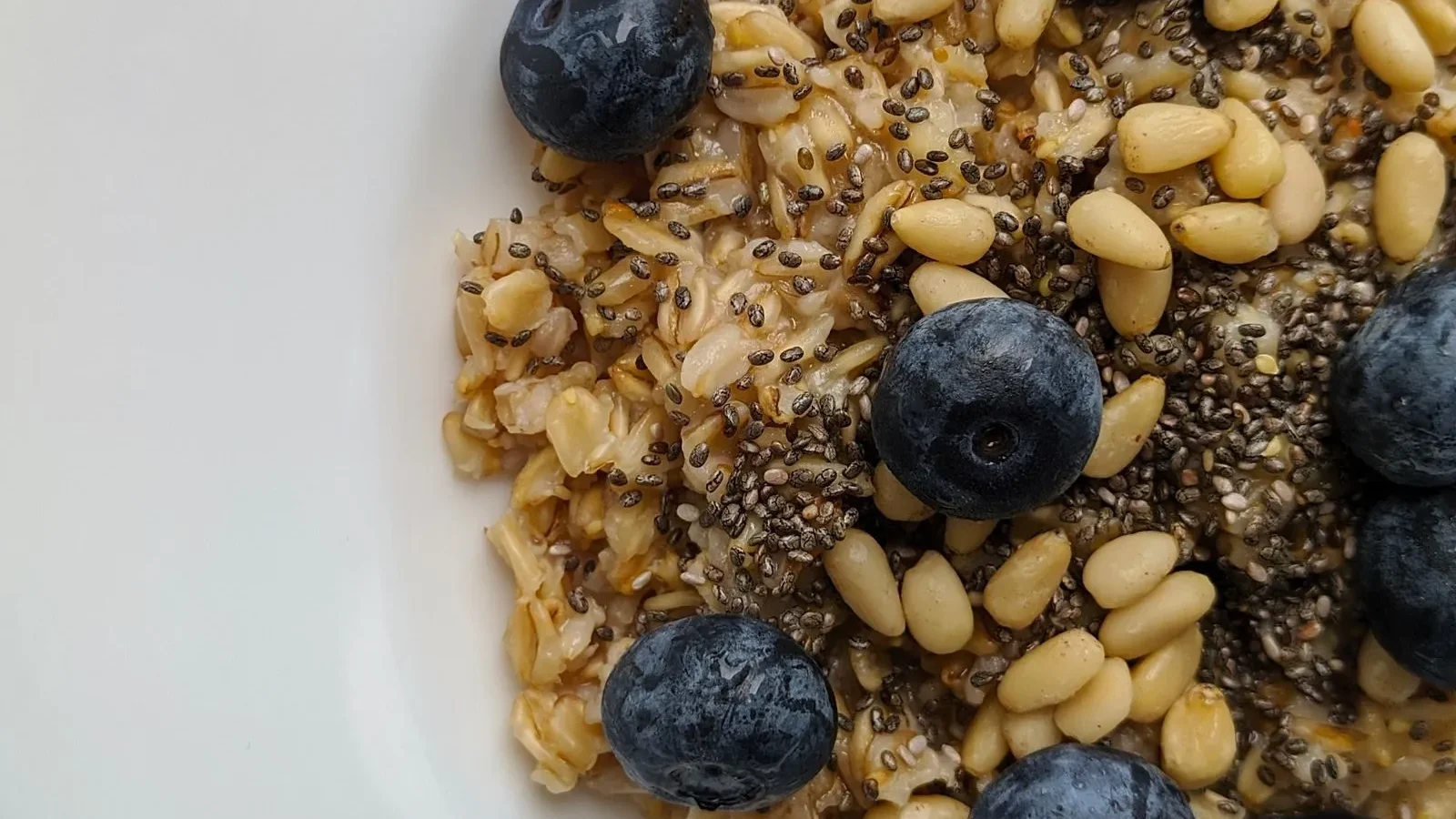
| Breakfast | Oatmeal made with soy milk, topped with berries and a few walnuts | Oat beta-glucan, soy protein, nuts |
| Lunch | Barley, lentil and vegetable soup with a side salad dressed in olive oil | Barley beta-glucan, pulses, unsaturated fat |
| Snack | A small handful of almonds and an apple | Nuts in place of chips or cookies |
| Dinner | Salmon or tofu stir-fried in canola oil with vegetables and brown rice | Fish or soy in place of fatty meat, unsaturated oil |
This day covers soluble fiber, nuts, plant protein and better fats without special products. Psyllium or a sterol-fortified food can be added if your doctor agrees.
Weight matters too. The NHLBI notes that adults with overweight or obesity can lower LDL and raise HDL by losing just 3% to 5% of their weight. Our guide to how a calorie deficit works explains how to set a realistic target.
Common mistakes that cancel out the benefits
- Expecting one food to do it all. A bowl of oatmeal helps, but the bigger changes in trials came from combining several foods and swaps.
- Adding nuts and oils on top of everything. They’re calorie-dense. Use them to replace butter, chips or fatty meat.
- Trading saturated fat for sweets. The NHLBI advises whole grains, fruits and vegetables rather than refined, high-sugar foods.
- Overlooking coffee. The 2021 review found that unfiltered coffee, made without a paper filter, raised LDL by a moderate to large amount.
- Assuming “plant-based” means heart-friendly. The NHS lists coconut oil and palm oil among the fats to cut back on.
- Using food as a reason to stop medicine. The NHLBI advises keeping up healthy habits alongside any prescribed medicine. Never stop a prescription without your doctor.
Get tested and know when food isn’t enough
High cholesterol usually has no symptoms, so a blood test is the only way to know your numbers. The NHLBI’s general guide suggests a lipid panel every 5 years for younger adults, every 1 to 2 years for men aged 45 to 65 and women aged 55 to 65, and every year after 65. Your doctor may test more often based on your risk and family history.
Some people have very high cholesterol for genetic reasons. Familial hypercholesterolemia is an inherited condition that affects an estimated 1 in 200 to 1 in 250 people and raises the risk of heart disease at a young age. It is treated with medicines and sometimes other procedures, with diet in a supporting role.