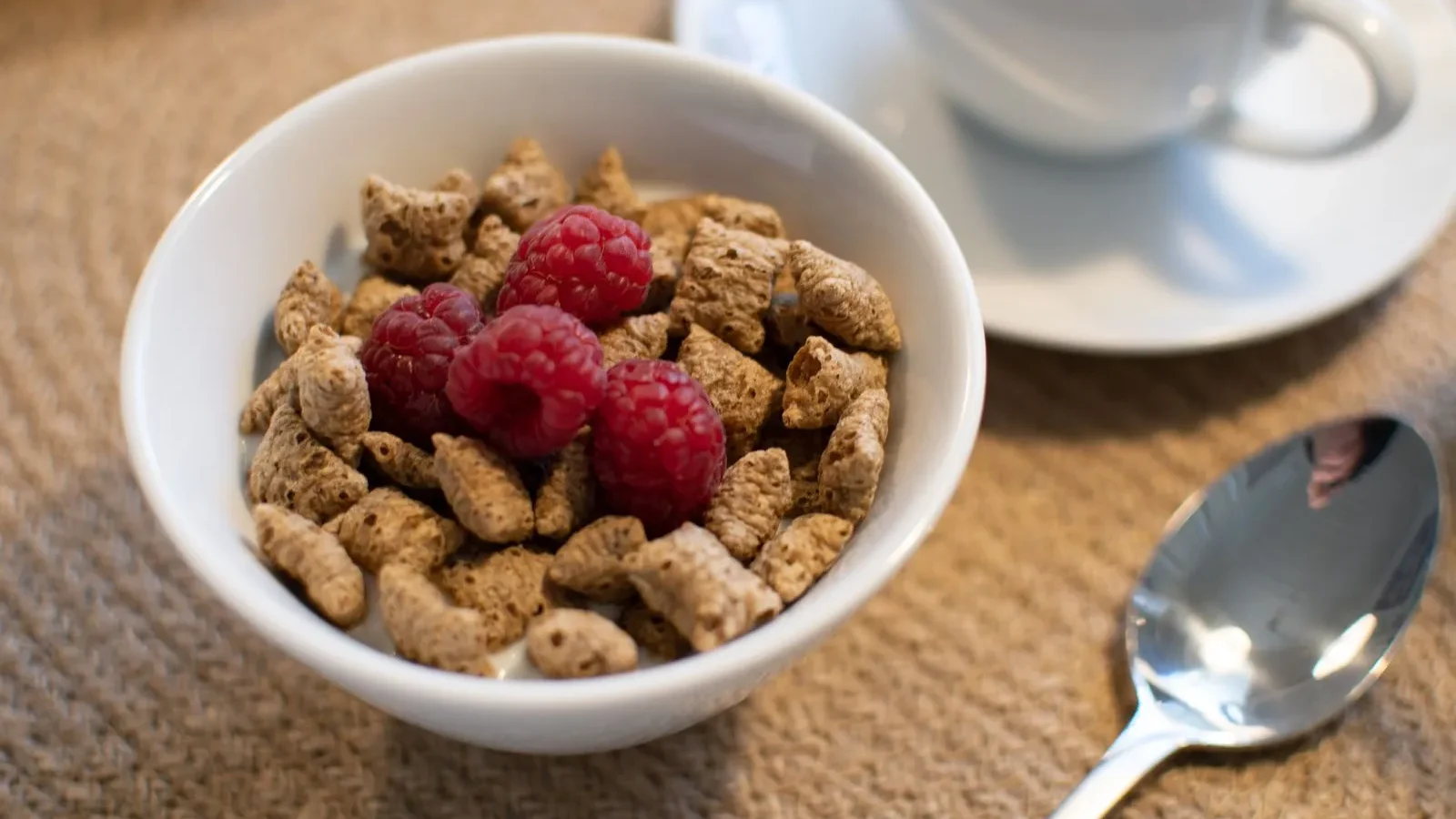
The best cereal for weight loss is the one that keeps you full for the fewest calories. In practice that usually means a whole-grain cereal with plenty of fiber, little or no added sugar, a measured portion and some protein on the side. Plain oatmeal, plain shredded wheat and bran flakes do well on those numbers; sweetened cereals and granola are easy to overdo.
No cereal burns fat or makes weight loss happen by itself, and no cereal will do it in days. What a good cereal can do is make breakfast filling and easy to repeat, which helps you stick to a calorie target you can actually live with.
This guide covers what to look for on the label, how common cereal types compare on USDA numbers, what the research says about whole grains and fiber, and how to build a bowl that lasts until lunch.
What makes a cereal good for weight loss
Four things matter more than any health claim on the front of the box:
- Whole grain first. The first ingredient should be a whole grain, such as whole wheat, whole grain oats or whole grain corn.
- Real fiber. Fiber adds bulk, and higher fiber intake is linked with better weight loss (more on that below).
- Low added sugar. Added sugar adds calories without making the bowl more filling.
- A portion you have measured. The same cup of cereal can hold 90 calories or more than 450, depending on the type.
Protein matters too, but most cereals are low in it. That is easy to fix with milk, yogurt or nuts, as you’ll see below.
What the research says about whole grains, fiber and weight
The evidence supports whole grains and fiber as helpers, not as weight-loss treatments. The difference matters when you’re choosing what to buy.
Fiber looks more promising. A 2019 analysis looked at 345 adults with overweight or obesity from the POUNDS Lost trial, who followed calorie-reduced diets for six months. Fiber intake was the most influential predictor of how much weight they lost in the researchers’ model, and higher fiber went with better adherence to the assigned diet.
That analysis shows a link, not proof that fiber caused the extra loss. People who eat more fiber may differ in other ways.
Oatmeal versus ready-to-eat cereal
In a 2016 crossover trial, 48 healthy adults ate either instant oatmeal or an oat-based ready-to-eat cereal with the same calories on different mornings. After the oatmeal they felt fuller and less hungry, and they ate less at a lunch served four hours later.
The researchers linked this to the oats’ soluble fiber (beta-glucan) and to the oats being sufficiently hydrated. It was a single-meal study, and four of the authors worked in PepsiCo’s nutrition research division, so treat it as a useful signal rather than the final word.
Federal advice points the same way. The Dietary Guidelines for Americans, 2025–2030 say to prioritize fiber-rich whole grains and to significantly cut back on highly processed refined carbohydrates, naming ready-to-eat and packaged breakfast options among the examples.
How to read a cereal label in 60 seconds
Start with the serving size
Every number on the label applies to one serving, listed in cups and grams. Pour your usual bowl into a measuring cup once and see how many servings you really eat.
Check fiber and added sugars with % Daily Value
The FDA’s general guide is simple: 5% Daily Value or less of a nutrient per serving is low, and 20% or more is high. The Daily Value for fiber is 28 g, and for added sugars it’s 50 g, a figure based on older advice to keep added sugars under 10% of daily calories.
So look for a high %DV for fiber and a low %DV for added sugars. The 2025–2030 Dietary Guidelines go further: they say no amount of added sugar is recommended, and one meal should contain no more than 10 g of added sugars (20% of the Daily Value), including anything you sprinkle on top.
Read the first ingredient
In its draft guidance on whole grain labels, the FDA says rolled oats and quick oats count as whole grains, because they keep the bran, germ and endosperm. The same guidance notes that “wheat flour” is simply another name for regular flour, with the bran and germ removed. Look for the word “whole” in front of the grain.
Note the protein
Most ready-to-eat cereals in the table below have only about 2 to 5 g of protein per serving shown. Plan to add a protein food rather than hunting for a cereal that has it all.
Cereal types compared: USDA numbers
The table uses generic cereal types from USDA FoodData Central, not brands. Look at the serving weights first: a cup of crisp rice weighs 25 g, while a cup of granola weighs 110 g.
| Cereal type | USDA serving | Calories | Protein | Fiber | Total sugars |
|---|---|---|---|---|---|
| Oatmeal (rolled or quick oats), cooked in water | 1 cup cooked (234 g) | About 165 | 6 g | 4 g | Under 1 g |
| Shredded wheat, plain | 1 cup (45 g) | About 160 | 5 g | 6 g | Under 1 g |
| Bran flakes, plain | 1 cup (50 g) | About 180 | 5 g | 10 g | 8 g |
| Wheat flakes | 1 cup (40 g) | About 145 | 4 g | 4 g | 6 g |
| Toasted oat O’s, plain | 1 cup (30 g) | About 110 | 4 g | 3 g | 1 g |
| Corn flakes, plain | 1 cup (30 g) | About 110 | 2 g | 1 g | 3 g |
| Crisp rice, plain | 1 cup (25 g) | About 90 | 2 g | Under 1 g | 2 g |
| Frosted corn flakes | 1 cup (40 g) | About 150 | 2 g | 1 g | 13 g |
| Sweetened oat O’s | 1 cup (40 g) | About 155 | 3 g | 3 g | 13 g |
| Granola | 1/2 cup (55 g) | About 230 | 5 g | 4 g | 12 g |
USDA lists total sugars for these entries, not added sugars, so check the label of the box you buy. Individual products vary, sometimes a lot. Numbers are for the cereal alone, without milk.
Oats and bran versus sugary cereals
Oatmeal is hard to beat. Cooked oats soak up water, so a cup is a big, warm bowl for about 165 calories, with 4 g of fiber and almost no sugar if you buy plain oats.
Plain shredded wheat is usually just whole wheat, with essentially no sugar and 6 g of fiber per cup. Bran flakes carry the most fiber per cup in the table, about 10 g, though they usually include some sugar.
Sweetened cereals have around 13 g of total sugars per cup in the USDA entries, and little fiber. Check the added sugars line on the box: if one cup provides more than 10 g, the cereal alone goes past the Dietary Guidelines’ cap for a meal.
Granola has a healthy image, but it’s usually made with added fat and sweeteners, which makes it dense. Half a cup is about 230 calories, so it works best as a topping of a few tablespoons rather than the whole bowl.
Light cereals such as crisp rice and plain corn flakes aren’t high in calories per cup. They are low in both fiber and protein, though, so on their own they may not keep you going until lunch.
Portion reality: why your bowl is bigger than the label
Cereal is one of the easiest foods to over-pour, because we judge portions by volume, not weight.
In a 2014 study, 41 adults served themselves breakfast cereal on four mornings. When the same wheat flakes were crushed into smaller pieces, people poured a smaller-looking bowl that actually weighed more. Their breakfast rose from about 286 to 358 calories on average, yet they believed they had taken the same amount each time.
Bowl math makes the point. A cup of granola with a cup of 2% milk comes to about 585 calories. A cup of bran flakes with a cup of fat-free milk is about 265, with more fiber.
- Measure your cereal for a week or two until you can recognize a cup by eye.
- Use a smaller bowl, and pour from a measuring cup rather than the box.
- Weigh dense cereals such as granola and muesli, where a small misjudgment adds a lot.
Our guide to how to control portion sizes has more simple tricks like these.
How to build a more filling bowl
Use a simple formula: a measured whole-grain base, a protein food, fruit and a small crunchy topping. Here’s what that looks like in practice, with totals built from USDA values.
| Bowl | What’s in it | Calories | Protein | Fiber |
|---|---|---|---|---|
| Bran flakes bowl | 1 cup bran flakes, 1 cup fat-free milk, 1/2 cup blueberries, 1/2 oz almonds | About 390 | 17 g | 14 g |
| Yogurt-topped oatmeal | 1/2 cup dry rolled oats cooked in water, 3 oz plain nonfat Greek yogurt, 1/2 cup blueberries, 1/2 oz almonds | About 330 | 18 g | 8 g |
| Shredded wheat bowl | 1 cup plain shredded wheat, 1 cup 2% milk, 1/2 cup blueberries | About 325 | 14 g | 8 g |
Notice how much of the protein comes from the milk, yogurt and nuts rather than the cereal. If you have a tree nut allergy, skip the almonds. A cup of fat-free milk adds about 8 g of protein for about 83 calories. If you’re unsure which milk suits you, see our guide to which milk is best for weight loss.
Our guide to how much protein you need to lose weight explains why protein matters while you’re losing weight and how much to aim for across the day. For more morning ideas, see how to make a healthy breakfast.
Common cereal mistakes
- Trusting the front of the box. Words like “multigrain” or “made with whole grains” don’t tell you how much whole grain is inside. The ingredient list and the fiber line do.
- Pouring by eye. As the flake-size study showed, your eyes are easy to fool.
- Treating granola as a diet food. It can be a good food, just in small amounts.
- Adding sugar on top of a sweetened cereal. Honey, syrup and sugar all count toward the 10 g added-sugar cap for a meal.
- Skipping protein. Most cereals have little of it, so add milk, yogurt, eggs or nuts.
- Jumping from low fiber to very high fiber overnight. A sudden big increase can cause gas and bloating. Increase gradually and drink enough fluids.
Cereal works best as part of an overall calorie target. If you don’t have one yet, start there.